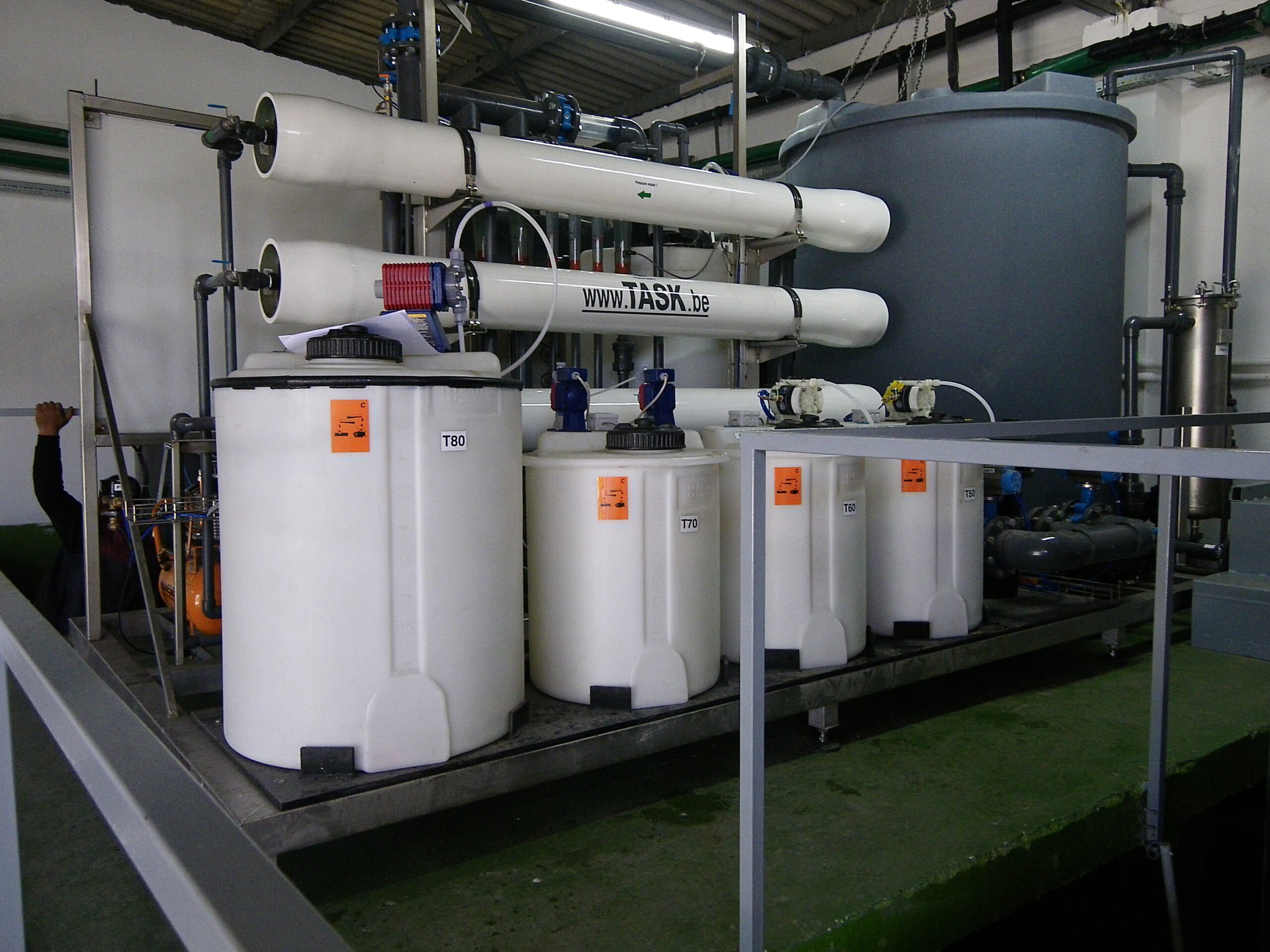
Radiator manufacturer Henrad, part of the Caradon Group, attaches great importance to environmentally friendly production. The Herentals-based company strives to respect the environment as much as possible in every possible way and to make the working environment for its people as healthy and pleasant as possible. To make the testing phase of the radiators more ecological and economical, the company appealed to Task. The company specialised in industrial environmental techniques, managed by Stefaan Kovács, worked out a satisfying solution in close collaboration with Henrad’s project manager
The project manager at Henrad is not only responsible for the buildings and broad infrastructure, but also constantly deals with environment-related issues. In this capacity, he determined that wastewater flows at Henrad could be optimised.
“Especially when testing our radiators, there was room for improvement,” he explains. “Our products are immersed in a test tank, where they are placed under pressure from compressed air, in order to detect any leaks. However, we were constantly noticing that the test trays got dirty quickly. This is quite logical, as the radiators made of large steel continue to carry oil traces from welding robots, among other things, and also caused microbiological contamination of the test tanks. That way, the water gets muddied. This is a problem, because only with clear water can the radiator test run optimally and our people can visually notice where the leaks are. Clear water is also necessary to prevent corrosion of the radiators and is better for the health of our employees.”
Thorough audit
Henrad used to solve that problem by changing the test tanks almost daily. For this procedure alone, this caused the company to consume 40 to 50 m³ of water per day. It led to a huge waste stream of contaminated water. “This all ended up in our traditional water treatment plant, which also had to process numerous other waste streams,” he says.
Therefore, in order to remain compliant with strict environmental standards, Henrad decided to stop discharging the water from the test bins and instead recover it. After consulting several partners, the company ended up with Task. “We had worked with this company before,” continues the project manager. “Previously, they installed an installation for the production of our process water at our premises during the process phase. Their satisfaction with that inspired our confidence.”
The first contact with Task dates back to early 2005. After a thorough audit and extensive lab tests, both parties took their time for a thorough evaluation of the problem and possible solutions. “After thoroughly weighing up the various offers, the decision was made at the end of 2006. Henrad finally opted for an installation based on ultrafiltration (membrane technology) adds Stefaan Kovács. “The choice of membrane, but also the preparation of the water was crucial to enable an optimally running treatment plant. Based on the tests carried out, a cross-flow ultrafiltration plant was proposed by Task. This is a batch-operated filtration process in which the wastewater offered is essentially concentrated several times.
The plant is designed for a capacity of 1,000 litres of permeate per hour, but in terms of performance it scores just about double those values.”
Seamless integration
The contaminated water enters the working tank with a COD value of 500 ppm and is concentrated by a factor of 30 to 50. The COD value of the permeate is below 50, while the water is also microbiologically fully disinfected. The light green colour of the permeate can be explained by the addition of a corrosion inhibitor, needed to protect the radiators tested.
“The concentrate is collected in a tank that is periodically emptied and disposed of. Henrad no longer needs to discharge the waste water stream. The permeate is collected in the permeate tank, from where the water leaves again for the test tanks. The energy requirement of the complete installation is approx.7.5 kW. The unit operates fully automatically PLC-controlled according to the Henrad standard. The system was fully customised and seamlessly integrated into the production process. The installation was installed in the production hall.”
Experience
The installation was commissioned at the beginning of 2007 and has been running at full capacity at Henrad in Herentals for several years. “The system operates smoothly and fully automatically,” the project manager clarifies. “That is not obvious, because it is often details that determine how successfully an installation works. I monitor the machine myself on a daily basis. Due to the very open communication with Task from the start, I was already familiar with the installation even before it was installed. We started from scratch at the time and now have a system that is fully adapted to our production process. Environmental progress was crucial for us, but the concept also saves costs on two levels. Not only do we no longer have to pump up water, the water from the test tanks no longer needs to be discharged. As a result, this company pays a much lower discharge fee.”
“The smooth operation of such installations stands or falls with the internal follow-up at the customer,” says Stefaan Kovács. “Henrad’s operating personnel do this very professionally and ensure the optimal condition of the membranes that ultimately form the heart of the entire installation.
A tailor-made solution
Task Industrial Environmental Engineering, located in Heist-op-den-Berg, has been run since 1997 by Stefaan Kovács, who himself has been carrying with him 35-40 years of expertise in the environmental sector. The company specialises in industrial air and water treatment and odour control for small and medium-sized enterprises. “We take care of the whole picture: from design to realisation, through conceptual and precise customisation. We particularly distinguish ourselves in the implementation of special environmental projects, where we certainly do not lose sight of the attention regarding the choice of materials but also the after-care that such installations require.
Task is not tied to fixed equipment suppliers and is not part of an umbrella holding company, which could impose certain purchasing requirements. “This independence allows us to choose the most suitable solution and the most cost-effective materials for each customer. We also attach great importance to the proper training of personnel on site, so that the plant can continue to operate in the best possible conditions in the long term.”
Task’s work area also includes the complete renovation and/or optimisation of existing water and air treatment plants. “More and more, we have to deal with customers who find after a few years that the installation chosen at the time no longer meets the current standard. It also often happens that the production capacity increases and the installation can no longer cope with this change. An optimisation and/or renovation then becomes necessary. As far as possible, existing elements are retained, in such a way that costs are kept as low as possible to achieve the intended and required result.”
Footnote
Henrad in Herentals, meanwhile, was closed. The same installations have also been in operation for many years at colleagues at Caradon Stelrad in Nuth Netherlands and TermoTeknik in Çorlu, Tekirdag, Turkey, all part of the Caradon Radiators group.
More on membrane filtration. More on water reuse.