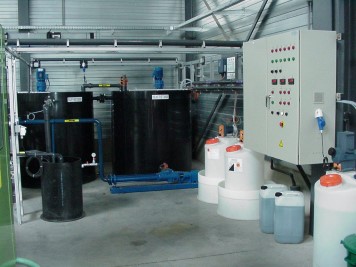
Industrial processes, such as metalworking and surface treatment, often release complex wastewater streams contaminated with heavy metals and other harmful substances. These substances – including zinc, copper, nickel, chromium and sometimes even cyanide – can cause serious environmental damage if not disposed of properly.
Physico-chemical treatment techniques offer an effective solution for treating such wastewater streams. Dissolved metals are converted via chemical reactions into insoluble compounds, which are then physically separated from the water.
Case study: Mauquoy Token Company – Olen, Belgium
For Mauquoy Token Company, a producer of high-quality metal coins and tokens in Olen, Belgium, TASK realised a customised physico-chemical water treatment plant. The challenge in this project was not only the removal of various heavy metals, but also the degradation of cyanide, a highly toxic substance that sometimes occurs in very small quantities in metal surface treatment.
The installation involves several process steps:
- pH correction to create optimal conditions for precipitation reactions.
- Coagulation and flocculation in which metals are converted into flakes that can be easily settled.
- Oxidation of cyanide to carbon dioxide and nitrogen.
- Sedimentation and filtration with a filter press to further dewater the sludge formed.
Result
Thanks to this installation, Mauquoy now meets the stringent discharge standards. The treated wastewater can be safely discharged, while the contaminated sludge is disposed of by authorised processors.
The approach at Mauquoy demonstrates how flexible and targeted physicochemical techniques can be used to treat complex industrial wastewater streams, even in the presence of difficult-to-remove components such as cyanide.