For a decade, Planckendael has been proving that its biorotor was the ideal choice to purify wastewater from its aviaries for sick birds. Unfortunately, few Belgian companies are following its example. And that is a pity, because the long-term benefits are not insignificant.
Planckendael is a spacious and open walking park with large animal enclosures that have been integrated into the landscape as well as possible. Some parts remain untouched, allowing visitors to find wild flowers and plants all year round. The estate attaches great importance to sustainable park management (this commitment was in fact rewarded with the Best Environmental Management Award by the FEB in 2004). And for fifteen years Prof. Rik Van de Werf, Lecturer in Environmental Care at the Erasmus University College Brussels and Lecturer in Environmental Techniques at the VUB, has played an important role in this area. For it was he who, in 1994, designed the installation for treating the waste water from a significant part of the animal enclosures, sanitary facilities in the park, animal kitchen and restaurant.
From waste to drinking water
Three years later, the park management knocked on the professor’s door again. Because Planckendael was forced to do something about the waste water from the breeding aviary. This was discharged into the Barebrook via a side channel, but new legal requirements required water treatment. After a thorough analysis, Prof Rik Van de Werf concluded that a biorotor with a helophyte filter was the best solution. He explains why: “This system offers great resistance to fluctuations in pollution levels: something that was necessary in this application, as there are more young birds in the aviary in summer, and therefore more polluting manure, than in winter. Moreover, it takes up little space. And that was a bonus: after all, we only had 100 m2 at our disposal.”
How does a biorotor work?
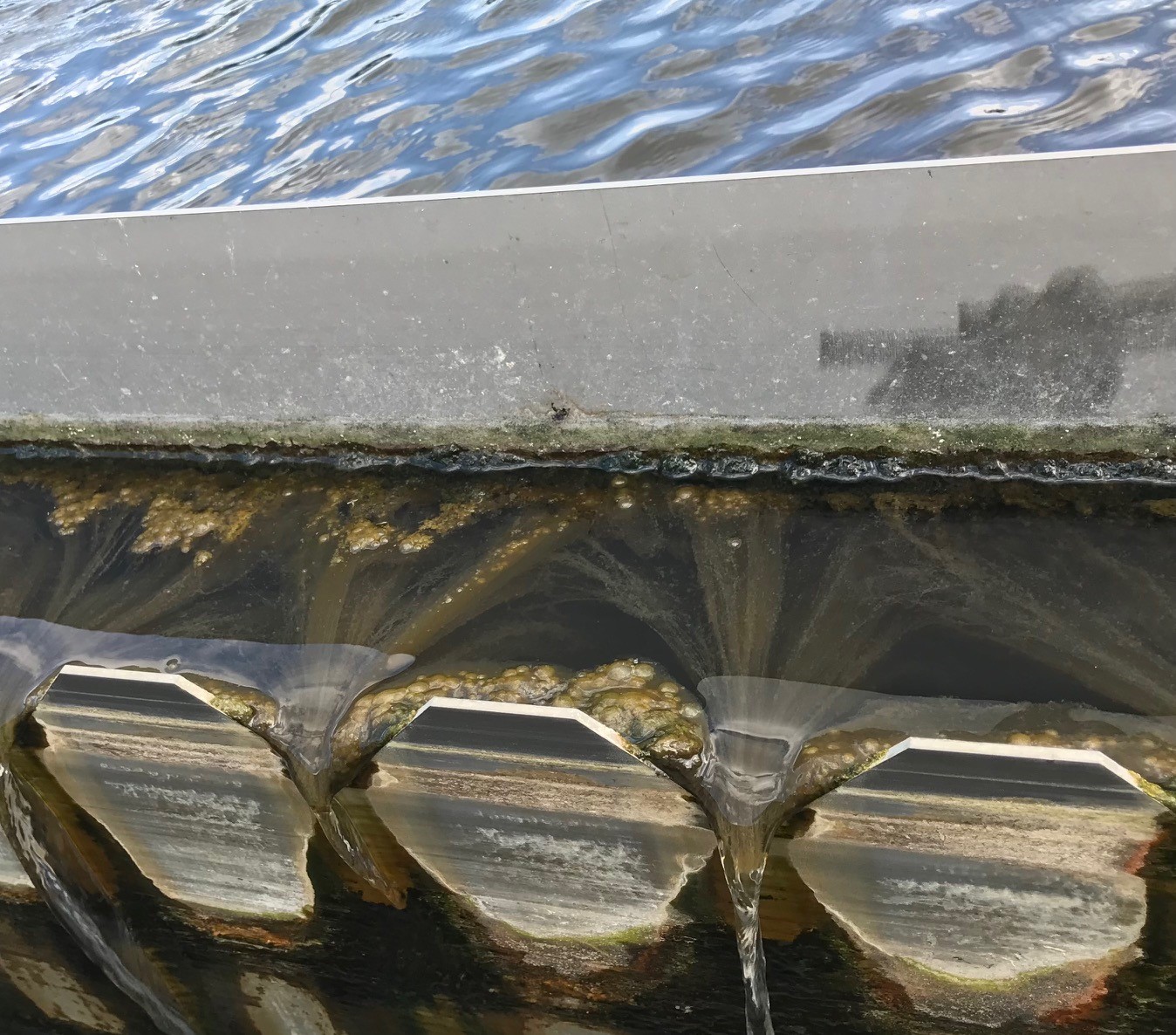
The biorotor consists of a cylinder containing a rotating shaft on which round discs are attached. “65 in total,” Prof Van de Werf clarifies. “At one end wastewater flows in, at the other end purer water flows out. Between all those round discs is a porous, synthetic filling. Each pore has a certain surface area. This is small, of course, but when you add it up from all the pores, you arrive at a total surface area that is very large. About a third of each disc hangs in the dirty water. When the shaft rotates, the wet part of the disc rises briefly to the surface each time. In this way, not only sewage, but also little oxygen from the air reaches the pores and the microorganisms growing in them. These micro-organisms use the dirt in the water as nutrients, making it purer. After a certain time, they form sludge slices between the discs, which detach, end up in the water as lumps and are separated from the water a little further by a sand filter.”
Because the wastewater is still not sufficiently clean after treatment with the biorotor, it is also sent through a helophyte field via the sand filter. Prof Van de Werf explains: “Helophytes are plants that are partially underwater, such as reeds. The water slowly ripples into the root zone of the field. Microorganisms grow on the roots of the plants, which also feed on the dirt of the water. Those that do not are in fact disadvantaged and go down in competition with those that do and therefore absorb more nutrients. By incorporating this dirt into their metabolism, they produce several substances that are in turn useful to the helophytes as nutrients. The plants themselves produce oxygen, which reaches the bacteria through the stem cavities, allowing them to breathe. In this way, the plants and the micro-organisms help each other and together extract the dirt from the water.”
Environmentally friendly and inexpensive system
This is a very environmentally friendly system that also works very cheaply: the purification of the water is completely natural, while the energy required is reduced to an absolute minimum (driving the shaft). The question then naturally arises as to why the solution is not widely adopted. Because the biorotor in Planckendael is not used very often, especially in an industrial environment. Stefaan Kovacs, Managing Director Task Industrial Environmental Engineering, which installed the treatment plant according to Prof Van de Werf’s design, explains. “Industry usually uses systems that work with activated sludge. In this, water is mixed with micro-organisms in large aeration tanks, resulting in sludge flakes that are separated from the water in a post-sedimentation basin. A biorotor works on the principle of the sludge-on-carrier system. Activated sludge systems are usually cheaper to buy (especially for residential and small-scale applications) than the biorotor and also do not require a second, separate step to completely strip the water of its nutrients.
Both the activated sludge system and the biorotor often do not clean the water sufficiently in basic configuration. But the activated sludge concept offers the advantage that the necessary additional treatment can usually be integrated into the existing plant, which is cheaper than switching a module after it, which would be necessary with a biorotor. An example of additional treatment that can be integrated into an activated sludge system is the removal of phosphorus and nitrogen from the wastewater. This phosphorus, for example, can be removed by adding certain chemicals such as iron or aluminium chloride while nitrogen is removed microbiologically. Nevertheless, I think these two disadvantages sometimes do not outweigh the advantages of the biorotor . For instance, the aeration of the biorotor is done naturally and without input of air by a compressor, by rotating the shaft with discs, and one simple motor is sufficient for this. In contrast, an activated sludge system requires several electrically controlled and automated air pumps to aerate the water, which increases energy consumption by up to 10 times.
Also, the system requires little maintenance and its principle is relatively simple, so any problem will be solved more quickly. The lower operating cost of biorotor aeration means it can be cheaper than other purification systems in the long run. And I haven’t even mentioned that such an installation requires little space… I think the industry has too limited an idea of the advantages of the biorotor, especially in the long term. Especially companies with waste products that are readily biodegradable should take a closer look at this solution. Just think of agricultural enterprises and the food processing industry, such as vegetable processing.”
Also for relatively small communal wastewater treatment plants, think of hard-to-reach residential areas, campsites and the like, a biorotor can offer an interesting alternative.
www.planckendael.be
source: Ecomagazine (June 2008)